
Express: Nothing Left to Protect
Once I stopped deciding whether the painting was working, I could finally work freely—pushing color, texture, and motion without a safety net.
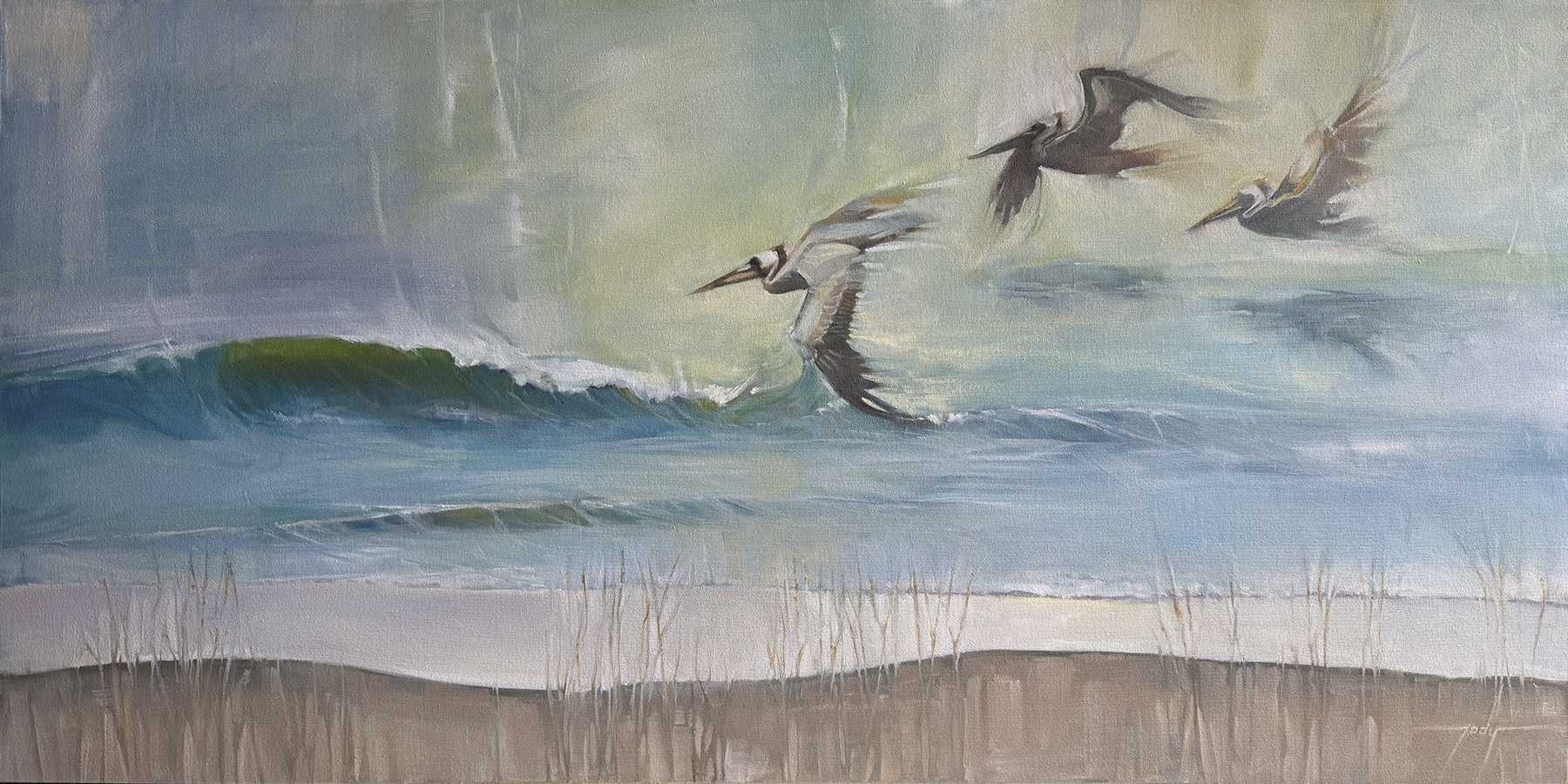
I signed the painting. I let it rest.
My daughter has a varied art and writing background coupled with a sharp, thoughtful eye. So I sent her a photo and asked for her personal evaluation. She spent time with the painting before responding, because that’s the way she rolls. Her feedback was specific and considered.
She felt I’d lost some of the original composition by pushing the values too hard, and that the heavy texture—especially in the background—may have tipped the balance. She thought the earlier, lower-contrast versions were easier on the eye. She liked the increased motion around the birds and the thought the reworked wave helped pull the birds into the composition. She was a bit skeptical of the vertical texture in the background as she thought it interrupted that movement. Maybe, she said, I’d gone too hard.
She loved the texture in the foreground, but thought the waterline carried too much contrast and distracted from the main energy. She did compliment the atmosphere, the water, and the warmth I introduced in the final version— she used the word “fantastic” which warmed my heart because moms don’t get to hear that word often enough—those changes resonated with her.
I took it all in. Not to go back to this painting—but to carry the ideas forward. To keep them in my pocket for future work.
Then she showed the painting to my mom. And my mom disagreed with almost everything. My mom is not an artist but she is definitely a consumer of art and an honest critic of my work. Maybe I should use the word “fantastic” for her more often. She also loved the new treatment of the pelicans—but unlike my daughter, she really liked the textured background. She felt the color palette was a clear improvement. What my daughter experienced as interruption, my mom experienced as richness. She didn’t understand why my daughter was distracted by the horizontal waterline.
I texted my daughter something like, “That’s the problem with art—you never really know if you did it right.”
And my daughter replied,
“That’s because you always somehow manage to make it right for some people and wrong for other people.”
Then she casually added: “Schrödinger’s Everything.”
Schrödinger’s theory suggests that until something is observed, it exists in multiple states at once—both true and not true. Only when observed does it collapse into a single outcome.
That idea lodged itself in me. Maybe that’s art.
Until it leaves my hands—until it’s seen—it exists in all states at once. Successful and unsuccessful. Too much and not enough. Working and not working. And once it’s out in the world, it doesn’t collapse into a single truth. It becomes many truths, simultaneously, depending on who’s looking.
That helped me stop trying to collapse the work into a single truth. I don’t need to make the painting right. I need to make it felt. To push past comfort. To use texture boldly. To exaggerate color. To let edges dissolve. To trust my instincts even when they contradict each other.
This painting didn’t teach me how to resolve itself. It taught me how to release control. And maybe that’s the real evolution—letting uncertainty guide the work and learning to enjoy the process of creating and releasing.
0 Comments